Dreamscapes
Featuring Works by India Raphael, Rai Barker, and Additional Artists
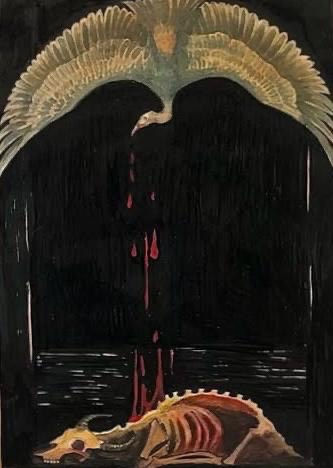
India Raphael
“All my art is about wanting to know about the unknown” India Raphael told me as we viewed her first solo exhibition together at The Art of Wonder at 147 High Street in Ryde.
The unknown – anything that is hidden – whatever is underground, buried or out of reach, the skeletons inside us – “the architecture of the body”, as India puts it, distant mountains, the mysterious and unfamiliar, the unattainable, the mythical and finally – looming larger than life in this list – I should mention death.
There is a memento mori – a reminder of the fragility of life and the mystery of what lies beyond it - in almost every one of this young artist’s works. Sometimes that reminder is present only in India’s impactful colour palette – desert ochres and sepias, stark bone whites against even starker blacks, with the occasional droplet of red.
If all this sounds macabre, that is not a word I would use to describe this exhibition. It oozes mystery and suspense and India’s style is distinctively luminous. Death – as we know – is a fact of life. India’s mother gave her the name of a country she yearned to visit, and the two of them would explore that country together, as well as other parts of Asia, on repeated visits throughout India’s childhood, travelling through and staying in areas less frequented by tourists. India attributes some of her fearlessness in the treatment of death in her art practice to learning of and being fascinated by the idea of 'sky burials' in Mongolia and Tibet where the body is offered to the vultures, or riverside cremations in her namesake country. Death, for India, represents rebirth. The skulls in her work are drawn from real skulls, found on walks, drawn in museums, or skulls given to her from collections accumulated by visitors to her studio.
India also is a land of many snakes, and the artist told me that they would regularly see five snakes in a day there, among them some of the most dangerous – banded kraits and cobras. Living there, she learnt to check her shoes, as often there would be a black snake that had curled up inside overnight. They were largely docile and often curious. India recounts how she would see water snakes swimming from a distance, which would disappear mysteriously, only to pop up by the bank to come and look at them. India finds it easy to empathise with the “underdog”, the despised and feared snakes and the vultures and corvids of this world – the creatures that are considered pests, and this interest is represented in this body of work by her frequent depiction of dragons – a development of the idea of the serpent. Associated with death and the gruesome as snakes, corvids and vultures may be, they are, in fact, India believes, a vital part of the cycle of life and renewal.
Asian influences aren’t immediately apparent in India’s depictions of scenes inspired by Cheddar Gorge and Glastonbury Tor and, even closer to home, Freshwater Bay with its bladderwracks and knotted and serrated wracks, drawn by India with painstaking detail. But they are there. The mouth of Glastonbury Tor is a gaping maw leading to a hidden underground cavern. The moon and a campfire are viewed through the entrance to a little-known cave in Cheddar Gorge which India visited with friends and inspired a dream of being a cave dweller in prehistoric times. However, it was India’s travels with her mother in Thailand that first sparked her interest in caves, where Buddhist holy men live and have their ceremonial sites.
The mystical is indeed present in India’s work, whether it be in Celtic myth, the influence of Tolkien and the Hobbit – India Raphael’s favourite book, or features of ecclesiastical architecture. Circles and triangles and spheres appear again and again in her works, and often seem to hold some undefined spiritual symbolism. India’s angels are no chubby cherubs, but are daunting constructions – I might almost say contraptions – of whirring feathers and eyes, awesome in their geometry. “Hence” says India, “their need to reassure with the words ‘Be not afraid!’ whenever they appear.” India recalls drawing temples and statues in Thailand and India when she was a small child, and she finds similar fascination in the curiosities of church and cathedral architecture in her home country.
Despite these earthier and more spiritual influences, I also sensed a hint of the industrial alongside the architectural in some of India’s work. Her mirrored skulls and wraiths have a meticulous, graphic quality, and her depictions of Glastonbury Tor a steely solidity.
This confident young artist is very aware of her influences, has developed her style in a thoughtful and deliberate way, modelling her use of colour on the earthy tones of the Pre-Raphaelites, taking inspiration from the biomechanical images of H.R. Giger and the soft fantastical landscapes of Tolkien illustrator Alan Lee and blending her own dreamscapes into the mix.
Rosemary Lawrey, curator


Rai Barker
A life-long artist, a graduate of the Royal College of Art and a yoga teacher, Rai Barker’s spirituality is evident in every painting. The brushstrokes are slow, careful, meditative and the treatment is sensitive. Painting, like meditation, Rai says, is a way of accessing and exploring her own feelings. “Painting can be really joyful, though not always. But it is always an emotional experience, and can be almost blissful”.A large part of that joy is to be found in the simple act of mixing colours. “I very rarely use paint straight from the tube” she says “I don’t even use much pure white”. Rai takes great pleasure in the discovery of how particular colours are arrived at, as well as the combinations that go to make up a particular hue in nature.
She has a keen eye for detailed observation, noticing often that the colours that are in the flower of a plant are also present in the leaf. Rai is interested too in the ingredients the first painters used to make a particular hue. “There is something almost magical about colour mixing – actually, it’s mind blowing!” Rai’s colour choices are instinctive, but she reflects on and questions those choices: “Yellow keeps popping up in my current abstracts. I love yellow, and I’m finding myself using a lot of it, but I wonder why. I use it rarely or sparingly in the garden, but I do like it on the canvas. I am using light colours now, which is surprising me and is a change – predominantly pale yellow, pale orange and pale lilac.” The element of magic has always been present in Rai’s choice of subject. “I see things in the everyday that aren’t necessarily there” she says. “Perhaps it’s a denial of reality, but I will always put something from my imagination into a realistic scene”.


Clare Short
Clare's work is recognised internationally and has even been presented to Pope Benedict XVI in Rome for his 90th birthday. As Clare describes it, her computer helps organise the chaos in her neurodiverse brain, acting as both her living paintbrush and her magical needle and thread.
This digital artwork draws on the beautiful Welsh legend of St Melangell, a 7th-century Irish princess who fled to Wales to escape an unwanted marriage and chose a life of solitude in the Pennant Valley in Powys. According to tradition, a hunted hare once sought refuge beneath her robe, causing the pursuing hounds to stop in their tracks. Moved by this moment, the local prince granted Melangell the valley as a sanctuary for prayer and the protection of wildlife. She later became an abbess and was venerated for her devotion, becoming closely associated with hares and the natural world. Her shrine still stands at St Melangell’s Church in Pennant Melangell and continues to inspire visitors today.